
PRODUCT
PRODUCT
CONTACT US
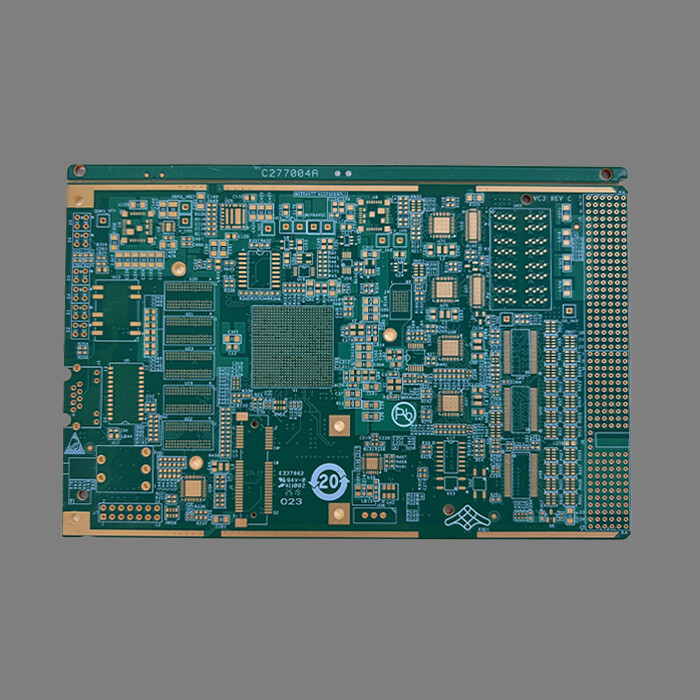
Commodity Name: Industrial Control Server Printed Circuit Board
Brand Name: HFast
Layers: 14L
Board Thickness: 2.0mm
Minimum Hole Size: 0.25mm
Minimum Line Width: 0.13mm
Minimum Line Spacing: 0.13mm
Color: Green Oil and White Legend
Surface Treatment: Gold Plating
Brief Introduction of Server PCB
The server PCB board is the core skeleton and nerve center of modern data centers and cloud computing infrastructure. They carry multiple high-performance CPUs, massive memory, high-speed network interfaces, storage controllers, and complex power and cooling systems. Their core mission is to provide an extremely stable, high-speed, and scalable computing platform in environments with extreme performance requirements, rigorous reliability requirements (7x24 hours of uninterrupted operation), high-density integration, and complex cooling challenges.
Characteristics of Server PCB
1. Multi layers;
2. High density interconnection;
3. High performance materials;
4. Strict signal integrity and power integrity design;
5. Powerful heat dissipation design;
6. High reliability and durability;
7. Large size.
The main types of Server PCB
1. Server motherboard:
The core board that carries the CPU, memory, and basic IO. Diverse forms (such as E-ATX, proprietary sizes).
2. Server Backplane:
Computing Backboard:Connect multiple CPU/memory node boards.
Storage Backplane:Connects a large number of hard drives (SATA/SAS) or SSDs (U.2, M.2), typically integrated with Expander chips.
*Network/IO Backplane: Centralized management of high-speed network interfaces and expansion slots.
*System Backplane: The core hub that connects computing nodes, storage nodes, power supplies, fans, management modules, etc. It is the "skeleton" and "nerve center" of the entire chassis, with the highest technical difficulty.
3.Specialized acceleration card/IO card:
Internal PCB boards such as GPU cards, FPGA cards, smart network cards, RAID cards, etc. also need to meet high reliability requirements.
Challenges and Trends of Server PCB
1. Challenge:
Physical limit approaching:Signal rate (PCIe 6.0/7.0, DDR6), power density continue to increase, and there is enormous pressure on heat dissipation and SI design.
*Design complexity skyrockets: multi-layer HDI、 The difficulty of simulating high-speed, high-power, and multi physics fields is exponentially increasing.
*High cost: High end materials, complex processes, multiple layers, and strict testing result in high costs.
*Supply chain and manufacturing yield: Relying on high-end materials from specific suppliers, high-precision manufacturing yield control is a continuous challenge.
Cooling bottleneck:As air cooling approaches its limit, liquid cooling (cold plate, immersion type) has become an inevitable choice, posing new requirements for PCB design (sealing, material compatibility, thermal interface).
2. Development Trends:
*Higher speed and bandwidth: PCIe 6.0/7.0, DDR6, CXL interconnect protocol popularized, 800G/1.6T network interface.
More advanced packaging and integration:
*Chiplet Design: The CPU/GPU itself uses Chiplets, which affects the packaging substrate and motherboard design.
*2.5D/3D integration: * * Using technologies such as silicon interlayer, EMIB, Foveros, etc., it is designed in collaboration with the motherboard PCB.
Optoelectronic co packaging:CPO technology co packages optical engines with electronic chips, significantly reducing high-speed interconnect power consumption and latency (especially crucial for 1.6T+networks).
*The popularization of liquid cooling: The integration of cold plate design into PCB heat dissipation solutions has become mainstream.
Higher density and integration:More layers, wider adoption of mSAP technology to achieve finer circuits and embedded component technology.
*Advanced materials: Continuously developing substrate materials with lower losses, higher thermal conductivity, and better adaptability to liquid cooling environments.
*AI Empowered Design: Utilizing AI to optimize wiring, heat dissipation design, predict performance, and improve yield.
*Sustainability: Focus on energy efficiency (reducing transmission losses), use of environmentally friendly materials, and design for recycle ability.
Summary of Server PCB
Server PCB is the cornerstone and engine of the modern data flood era. They represent one of the highest levels of current PCB design and manufacturing technology, seeking a delicate balance under multiple constraints such as extreme performance, ultra-high density, massive power supply, rigorous reliability, and complex heat dissipation. Its complexity and technological threshold far exceed those of ordinary consumer electronics product PCBs, and it is the core hardware foundation that supports key applications such as cloud computing, artificial intelligence, and big data. Understanding the special requirements and technical points of server PCB is the key to designing, manufacturing, and operating high-performance and highly reliable server systems. With the continuous explosive growth of computing demand, server PCB will continue to evolve towards higher performance, higher integration, smarter heat dissipation, and more advanced interconnection, constantly challenging the limits of engineering technology.
Online Message
Application

CONTACT US
Please use the form below to get in touch.
If you need a reply we will get in touch as soon as possible.